





Machining
Machining: Precision and Engineering in Metal Shaping
Machining, the cornerstone of industrial production, is the process of giving a workpiece its targeted form, dimensions, and surface quality by removing material in layers (chips) with the help of cutting tools. At Fintherm, the machining methods we utilize in the production of heat exchangers and energy system components are focused on micron-level precision, high repeatability, and material efficiency. This method is indispensable for bringing raw parts obtained through casting or forging to final technical drawing tolerances, or for creating complex geometries from solid material. Today, with the introduction of computer-numerical control (CNC) systems, human error has been minimized, and production speeds have been maximized.Basic Machining Methods
The method to be used in machining is determined by the part’s geometry, material hardness, and desired surface roughness. The primary methods are:- Turning: The removal of chips from a workpiece rotating around its own axis using a stationary cutting tool. It is the primary method for producing cylindrical and circular-shaped parts (shafts, flanges, etc.).
- Milling: The removal of chips from a stationary workpiece using multi-point cutting tools rotating around their own axis. Flat surfaces, slots, and complex 3D forms are processed using this method.
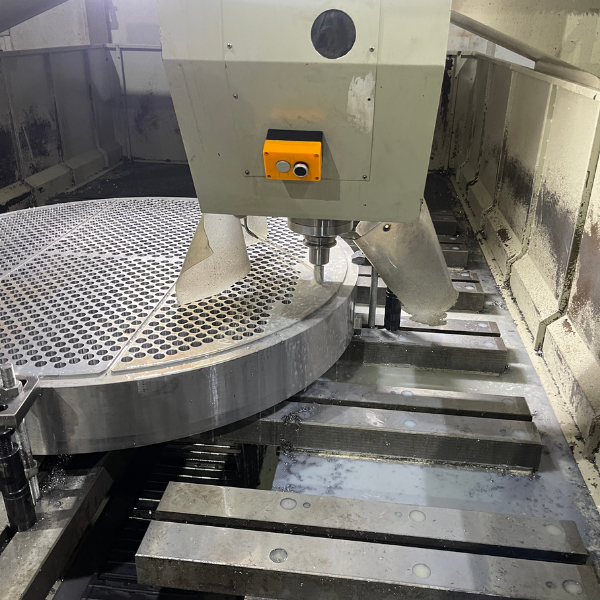
- Drilling: A method used to create cylindrical holes in a workpiece. it plays a critical role in the precise hole patterns of heat exchanger tube sheets.
- Grinding: A precision finishing process using abrasive wheels for cases requiring very high surface quality and tight tolerances.
CNC Technology and Digital Production
The integration of traditional machining methods with digital control systems (CNC – Computer Numerical Control) has defined the standards of modern manufacturing. CNC machining processes offer the following advantages:- High Precision: Consistently achieving tolerances at the level of 0.01 mm.
- Complex Geometries: The ability to process complex 5-axis forms that are impossible to create with manual lathes.
- Mass Production: The ability to produce thousands of programmed parts with the same quality.
- Cost Effectiveness: Reduction in processing times and a decrease in the rate of defective parts (scrap).
Materials Science and Cutting Tool Selection
The secret to success in machining lies in the harmony between the material being processed and the cutting tool. The primary materials we process at Fintherm include stainless steel, carbon steel, copper alloys, aluminum, and titanium. Specially coated (TiN, TiAlN, etc.) carbide or diamond-tipped tools are used for each material. The use of high-pressure cooling fluids (boron oil or synthetic oils) to remove heat generated during the process and reduce friction are factors that directly affect surface quality.Project Process
Product Photos


Frequently Asked Questions
01.
What are the advantages of machining compared to other manufacturing methods (casting, forging, etc.)?
Machining allows for the achievement of micron-level tolerances and surface roughness values that casting or forging methods cannot reach. Furthermore, because it does not require mold costs, it is a much faster and more economical solution for prototype production and the manufacturing of complex parts in low quantities.
02.
What is the most critical role of machining in heat exchanger and radiator production?
Sealing is of vital importance in heat exchangers. Machining is particularly used in the processing of tube sheets and flange surfaces. Drilling the holes for the tubes without axial misalignment and with precise tolerances is the most fundamental element in guaranteeing assembly quality and the lifetime sealing of the system.
03.
What does "Number of Axes" (3, 4, 5 axes) indicate in CNC machining centers?
The number of axes determines the movement capability of the cutting tool or workpiece. 3-axis systems move in the X, Y, and Z planes, while 5-axis systems perform rotational movement in two different angles in addition to these movements. 5-axis technology allows for the machining of entire surfaces and the production of very complex forms by clamping the workpiece to the machine in a single pass.
04.
How do cutting speed and feed rate affect surface quality?
Cutting speed is the rotational speed selected according to the type of material; feed rate is the linear movement of the cutter across the workpiece. The lower the feed rate, the less surface roughness is achieved. However, for ideal surface quality, the correct combination of speed, feed rate, and cutting tool geometry suitable for the material's hardness is essential.
05.
What is the purpose of using "Coolant" (Boron Oil) in machining?
During cutting, temperatures reaching up to 1000°C can be generated due to friction. Coolants both extend the life of the cutting tool by dissipating this heat and ensure the removal of chips from the area. They also reduce friction between the workpiece and the cutting tool, preventing overheating and improving surface quality.
06.
How is the "Surface Roughness" (Ra) value measured after machining?
After machining, the surface quality is measured by the Ra value, which is the average of the peak and trough values at the microscopic level. "Profilometer" devices, which have a sensitive probe, measure this value by passing over the part. In heat exchanger gaskets, a specific roughness range (usually Ra 3.2 - 6.3) is targeted for leak-proof sealing.