





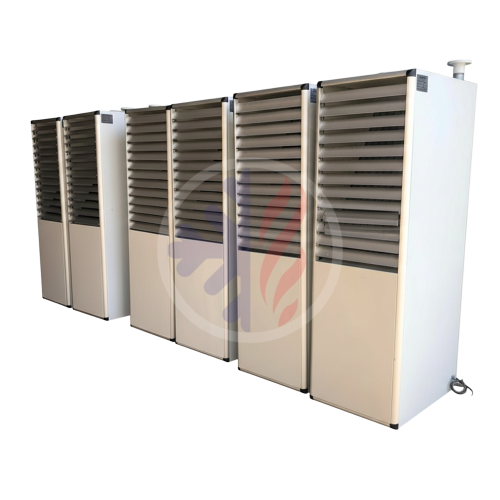
Unit Heaters
Heating Units: Economic and Practical Heating for Large Volumes
In large-volume spaces such as factories, warehouses, supermarkets, gymnasiums, and meeting halls where traditional heating methods fall short, heating units (unit heaters) offer both an economic and extremely practical solution. Fintherm heating unit systems provide a homogeneous temperature distribution by rapidly conditioning the ambient air and minimizing operating costs. Equipped with a high-efficiency coil structure and a powerful fan system, these units achieve comfort conditions in large areas in a short time. When choosing a heating unit, the physical characteristics of the space and the purpose of use are the most decisive factors. Using the correct type of unit not only increases heating quality but also maximizes energy savings.Choosing a Heating Unit Based on Space Dynamics
Fintherm offers two basic model configurations based on the height of the space and acoustic requirements:- Ceiling-Type Units: Ideal for spaces where silence is prioritized, such as meeting rooms, libraries, and offices. These units, mounted on the ceiling, distribute the heated air by filtering it from top to bottom, offering a peaceful environment with low noise levels.
- Wall-Type Units: Preferred in places with high ceilings where large volumes need to be heated, such as factories, workshops, and hangars. Wall-type units, which have a longer blowing distance, create a balanced temperature at every point by reaching the heated air to distant locations.
Technical Advantages of Heating Units
Fintherm hot air unit designs have been developed based on durability and high performance:- High-Efficiency Coil: The heating battery, consisting of copper tubes and aluminum fins, transfers the energy of fluids such as hot water or steam to the air in the fastest way.
- Adjustable Louvers: Thanks to the guiding louvers at the discharge outlet, the hot air flow can be manually directed to the area intended to be heated.
- Compact Structure: With its modern external body structure, it aesthetically blends into all types of industrial or commercial interiors.
- Low Energy Consumption: Thanks to the optimized motor-fan group, it offers maximum airflow with minimum electricity consumption.
Application and Layout Planning
The placement of heating units in large areas should be planned so that no “dead zones” remain. Especially in large factories, arranging the units in a diagonal or sequential pattern to support each other can significantly shorten the heating time. The height from the ground and the blowing angle of wall-mounted units should be adjusted to ensure that the airflow reaches the floor without disturbing the employees.Project Process
Product Photos


Frequently Asked Questions
01.
In which sectors are heating appliances used?
It can be safely used in factories, warehouses, production areas, greenhouses, gyms, power plants, and all high-volume industrial areas.
02.
Is energy consumption high?
Depending on the device's capacity, modern appliances offer low energy consumption thanks to their highly efficient coil structure and optimized fan speed.
03.
Are these appliances effective in areas with high ceilings?
Yes. Especially in large spaces with high ceilings, it performs very effectively by ensuring downward heat transfer thanks to its high airflow rate.
04.
What is a heating device and how does it work?
A heating unit is a compact unit consisting of a heating coil (serpentine) through which hot water, superheated water, or steam passes, and a fan located behind this coil. The fan heats the air it draws from the environment by passing it through hot fins and blows it powerfully into the room. Because it moves the air much faster than a static radiator, it heats large spaces in a short time.
05.
What is the difference between a hot water heater and a steam heater?
The main difference lies in the type of fluid that flows through the heating coil. Hot water units typically operate with water at 70-90°C and are ideal for standard factory heating. Steam units, on the other hand, use steam, which has a higher energy density; they provide much faster heating, but the coil design must be of a special structure (usually steel tubing) that can withstand high pressure and temperature.
06.
Should you choose a ceiling-mounted or a wall-mounted fixture?
If your ceiling height is less than 4-5 meters and quietness is important (office, shop, showroom), ceiling-mounted air conditioners are suitable. If your ceiling height is high and you want to prevent heated air from accumulating at the top and direct the air more strongly to the floor (factory, warehouse, hangar), wall-mounted air conditioners are more efficient with their longer blowing distances.