





Shell and Tube Heat Exchanger
Shell and Tube Heat Exchanger: The Powerful Center of Industrial Heat Transfer
One of the most critical pieces of equipment in industrial facilities, the **shell and tube heat exchanger**, is a system that allows two fluids at different temperatures to transfer heat across a wide surface area without mixing. The shell and tube heat exchangers we design as Fintherm are known for their superior performance under high pressure (350 bar shell, 1400 bar tube) and extreme temperature (200°C – 600°C) conditions. These exchangers offer thermal shock-resistant and long-lasting solutions in a wide range of applications, from oil refineries to food factories. The basic operating principle of the system is that one fluid flows through the inside of the tubes (**tube side**), while the other fluid flows through the shell surrounding these tubes (**shell side**). To maximize heat transfer, **corrugated** or **turbulator** tube technologies are utilized inside the tubes.Structure and Basic Components of Shell and Tube Heat Exchangers
Fintherm shell and tube heat exchangers are manufactured in accordance with international standards (TEMA, ASME, EN 13445) consisting of three main parts:- Front Header (Stationary Head): The section that regulates the entry of the fluid into the tube side.
- Shell: The cylindrical structure surrounding the tube bundle where the shell-side fluid circulates. Expansion joints (bellows) used to absorb thermal expansion are located in this part.
- Rear Head: The section where the fluid completes the tube circuit or makes a return.
- Tube Bundle and Tube Sheets: Perforated plates (tube sheets) where the tubes are fixed, preventing the fluids from mixing. Tube pitches are generally designed in a triangular or square arrangement, typically 1.25 times the tube diameter.
Design Types: U-Tube and Straight-Tube Exchangers
Fintherm offers two basic designs based on the physical and thermodynamic requirements of the process:- U-Tube Heat Exchanger: In this model, where the tubes are bent into a “U” shape, the structure naturally compensates for expansions caused by high temperature differences. It is preferred in areas requiring high capacity and systems where the pressure resistance of a circular cross-section is utilized.
- Straight-Tube Heat Exchanger: A model where the tubes are fixed on a straight line with tube sheet connections. Its biggest advantage is that the inside of the tubes can be easily cleaned mechanically. It offers high performance up to 350°C in food and chemical sectors where hygiene is critical.
Material Selection and Manufacturing Technology
During the **shell and tube heat exchanger manufacturing** process, material selection is determined by our expert team according to the corrosive effect and temperature of the fluid. For tube materials; copper, stainless steel, carbon steel (drawn or welded), cupro-nickel, brass, or titanium can be used. On the shell side, a wide range is available from carbon steel to duplex steels. The **baffling** design is of critical importance in manufacturing. Baffles force the shell-side fluid to zigzag around the tube bundle, maximizing turbulence and therefore the heat transfer coefficient.Usage Areas and Sectoral Applications
Thanks to their flexible design and durability, these exchangers find a place in almost every industry:- Oil and Refinery: Crude oil heating, gas liquefaction, and heavy oil cooling.
- Power Generation: As condensers and steam generators in thermal and nuclear power plants.
- Textiles and Dyeing: Precise temperature control in yarn and fabric dyeing machines.
- Maritime: Cooling of ship engines using seawater.
- HVAC and Food: Central heating systems, pasteurization, and chiller cooling groups.
Our Project Process
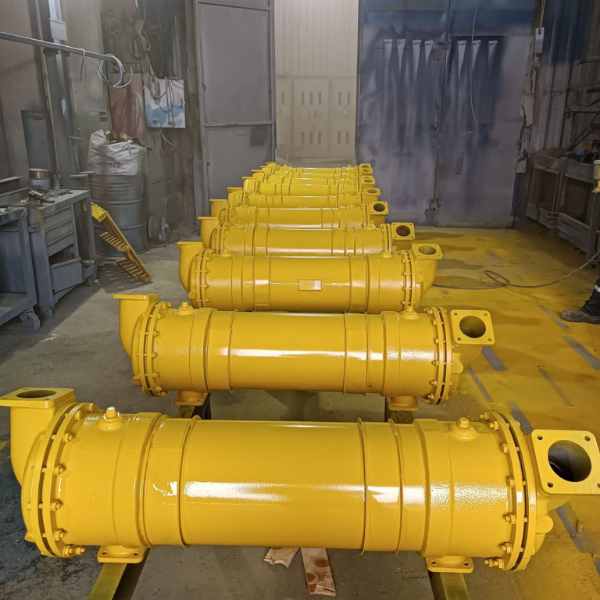
Product Photos



Frequently Asked Questions
01.
What is a shell and tube heat exchanger, and how does it differ from a plate heat exchanger?
Shell and tube heat exchangers are the most resistant type of heat exchanger to high pressure and temperature differences, consisting of a bundle of tubes placed inside a cylindrical shell. Their biggest advantage over plate heat exchangers is their ability to operate at much higher operating pressures, their greater tolerance to fouling, and the fact that the inside of the tubes can be mechanically cleaned.
02.
What materials are used to manufacture your products?
Carbon steel, stainless steel, copper, copper-nickel, and other alloys suitable for process requirements can be used. Material selection is determined according to fluid properties and temperature requirements.
03.
How is the testing process for heat exchangers carried out?
All heat exchangers undergo leak testing, hydrostatic pressure testing, welding inspections, and visual quality checks. Additional performance tests are conducted as needed, and the results are reported.
04.
In design, what criteria are used to select "Pipe Side" and "Shell Side" fluids?
Generally, high-pressure, more contaminating (fouling), or more corrosion-prone fluids are supplied to the tube side; this is because cleaning the inside of the tubes and using corrosion-resistant, specially alloyed tubing is more economical than making the entire shell from special materials. Low-pressure or clean fluids are supplied to the shell side.
05.
What is the function of the "baffles" inside a heat exchanger?
The baffle plates within the shell perform two primary functions: firstly, they provide mechanical support to the tube bundle, preventing vibration; secondly, they increase turbulence by forcing the fluid on the shell side to zigzag around the tubes. This turbulence increases heat transfer efficiency by several times compared to straight flow.