





L Finned Tube
L-Finned Tube Heat Exchanger: Economic Solutions for Low-Temperature Applications
Developed to optimize the balance between cost and performance in heat transfer processes, the L-Finned Tube Heat Exchanger is an ideal finned tube technology, especially for low-temperature applications. The L-type fin structure covers the tube surface helically, both expanding the heat transfer surface and providing a certain degree of protection for the tube wall against external factors. Produced with Fintherm quality, these heat exchangers increase heat transfer efficiency thanks to their compact structures and high contact surfaces. The most distinctive feature of L-finned tubes is that the production technology allows the use of tubes with thin wall thicknesses. This situation reduces the total weight of the system while providing an advantage in investment costs.L-Finned Heat Exchanger Manufacturing and Structural Features
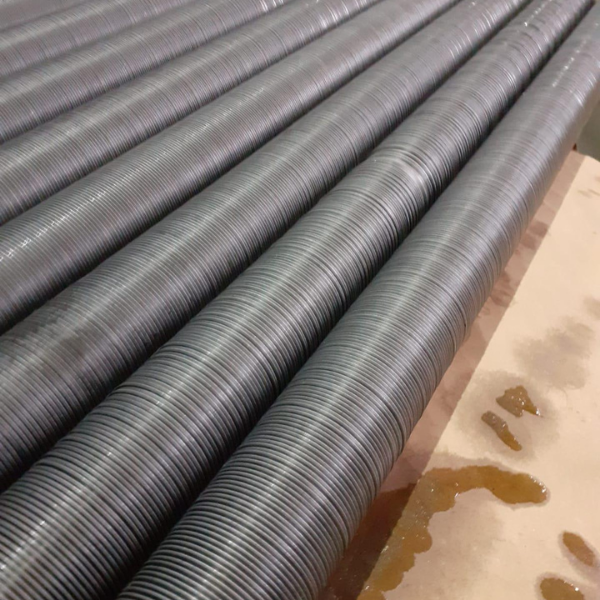
L-finned heat exchanger manufacturing is carried out by wrapping the fin feet around the tube under tension, giving them a special form. Since each fin foot is in adjacent contact with the next fin, it completely covers the tube surface. This production method offers acceptable corrosion resistance in non-highly abrasive environments.- Maximum Operating Temperature: The recommended upper limit for these systems is 150°C.
- Material Combinations: While aluminum and copper are generally preferred as fin materials, a wide range from carbon steel to copper can be used as tube materials without any limitations.
- Mechanical Strength: By its nature, it has low mechanical strength; therefore, it is preferred in areas that do not receive direct impact or do not require high-pressure cleaning.
Spiral Finned Heat Exchanger Types and Fluid Compatibility
The spiral finned heat exchangers we manufacture as Fintherm are diversified with materials suitable for various fluid types such as air, water, seawater, steam, and thermal oil. Depending on the chemical and thermal needs of your project, you can choose from the following types:- Stainless Systems: Models with high corrosion resistance produced using stainless steel for both the tube and the fin parts.
- Copper Systems: Solutions providing maximum thermal conductivity with a combination of copper tubes and copper fins.
- Carbon Steel Models: Economic models produced by wrapping DKP (cold-rolled steel) fins onto carbon steel welded or seamless tubes.
- Special Alloys: Copper or DKP fin wrapping on special alloy tubes such as cupronickel (bafon) and brass.
- Resistive Models: Electric heater exchangers produced by wrapping DKP or stainless fins over heating elements (resistances).
Advantages of Using L-Finned Tubes
L-Finned tubes stand out especially in heating/cooling lines where the risk of corrosion is low and budget-friendly solutions are sought. The L-foot structure, which completely closes the tube wall, provides protection against atmospheric corrosion, while the high thermal conductivity provided by copper and aluminum fins guarantees system efficiency. Designed with Fintherm engineering, these heat exchangers offer a professional heat transfer surface that extends the life of the installation.Project Process
Product Photos


Frequently Asked Questions
01.
What is an L-Finned Tube (L-Fin) and what is its operating principle?
An L-finned tube is a type of heat exchanger where the fin strip is bent into an "L" shape and tension-wound tightly onto the tube surface. The L-shaped foot sits flush against the tube surface and joins with the next fin, covering the tube like a helical sheath. This structure creates a wide contact area between the tube and the fin, ensuring rapid heat transfer.
02.
How does the L-type fin structure provide protection against corrosion?
In the L-fin structure, as the horizontal foot of the fin completely covers the tube surface, the contact between the tube and the atmosphere is significantly interrupted. This feature delays the oxidation of the tube in environments without high corrosion risk and extends the system's lifespan. However, since it does not provide a complete seal, it is not as resistant as LL or G-finned tube models in aggressive chemical environments.
03.
Why is the maximum operating temperature of L-finned tubes limited to 150°C?
In these finned tubes, the fins are attached to the tube via mechanical tension. At temperatures above 150°C, the fin material (usually aluminum) expands more than the tube material, which can cause it to lose contact with the tube (loosening). This loss of contact results in an abrupt drop in heat transfer efficiency.
04.
In which situations should Extruded or G-finned tubes be preferred over L-finned tubes?
If the operating temperature is above 150°C, if the system is to be cleaned with high-pressure water, or if it will operate in an environment with very intense vibration; G-finned (embedded) or Extruded finned tubes, which have higher mechanical strength, should be preferred over L-finned tubes.
05.
How is material selection performed for L-finned tubes?
In Fintherm production, while carbon steel, copper, or stainless steel is used as the tube (main pipe) material; aluminum or copper, which have high thermal conductivity coefficients, are preferred as the fin material. For systems where economy and lightness are sought, the "Copper Tube - Aluminum Fin" combination is the most popular option.